

1. What Is a Crypto Debit Card and How Does It Work?
A crypto card is a physical or virtual payment card that lets you spend cryptocurrency at any merchant that accepts standard Visa or Mastercard payments. Instead of manually selling coins and moving cash to a bank, the card handles the conversion for you, you tap or swipe, and the merchant receives ordinary fiat currency such as euros.
There are two main mechanics behind these cards:
- Real-time conversion at the point of sale. The card is linked to an exchange or wallet balance, and your crypto (or stablecoin) is sold for fiat at the moment you pay. Assets are converted to fiat in real time when transactions occur on cards such as Bybit's, for example.
- Pre-loaded fiat wallet. You convert crypto to fiat inside the app first, and the card spends from that fiat balance. With Crypto.com you top up the prepaid balance with fiat or crypto, add the card to Apple Pay or Google Pay, and spend at any Visa merchant, with CRO cashback posting to your app wallet within about a day.
The distinction matters for everyday usability and, crucially, for taxes. In many jurisdictions, selling crypto, even to buy a coffee, is a taxable disposal event. Cards funded by stablecoins such as USDC or USDG reduce that headache, because a stablecoin's value tracks the dollar and generates little or no capital gain on each swipe.
Crypto Visa Card vs Crypto Mastercard
In practice, both networks are accepted at tens of millions of merchants worldwide, so acceptance rarely decides the matter. The bigger difference is which issuer sits on which network. Crypto.com's cards run on Visa, and neither touches Mastercard, while the Nexo Card is a Mastercard, and the Bybit Card is a Mastercard debit card. Most of these cards support contactless payments and add to Apple Pay and Google Pay in eligible markets, so your phone works as the card.
How Crypto-to-Fiat Conversion Works at the Point of Sale
A single tap hides several steps. You present the card, the app locks an exchange rate, your chosen crypto or stablecoin is debited, and the merchant is settled in local fiat over the card network. The cost you pay is the spread, the small gap between the market rate and the rate you receive. On the OKX Card, for instance, USDC or USDG is converted to euro at the moment of purchase via the Mastercard network with no transaction or FX fees from OKX, only a 0.1% market spread. Timing matters with volatile assets, which is exactly why stablecoin-backed cards have become the calmer default for everyday spending.
2. How We Ranked the Best Cryptocurrency Cards of 2026
We assessed each card against eight criteria, then wrote an honest verdict for each rather than crowning a single winner. No card is entitled to appear first by default, where the reviews below follow an order, it runs from broadest everyday usefulness toward more niche picks, and we say plainly which reader each card suits.
The eight evaluation criteria:
- Rewards and cashback rate, the real earned rate, not just the headline ceiling.
- Fee structure, annual fee, ATM fees, and foreign transaction (FX) fees.
- Supported cryptocurrencies, BTC, ETH, stablecoins, and altcoins.
- Geographic availability, verified country by country, never described as "global" unless confirmed.
- Spending and ATM limits.
- KYC and onboarding friction.
- Security features.
- Customer support quality.
A note on independence: MyCardCompare's editorial assessments are separate from any commercial relationship. Where a card carries a live sign-up offer sourced through a direct issuer relationship, that relationship funds the offer for users, it never buys a higher ranking or a better score. Offers and rankings are reported as two separate facts. This article is comparative information, not personalised financial advice, and none of it implies you will be approved for any card.
3. Best Crypto Cards of August 2026 at a Glance
The table below summarises the eight cards on the figures that decide most choices. Full reviews follow; all rates are current as of August 2026 and can change on issuer refresh.
Card | Network | Best for | Cashback rate | Annual fee | FX fee | Supported crypto | Availability |
|---|---|---|---|---|---|---|---|
Crypto.com Visa (prepaid) | Visa | Committed CRO stakers/subscribers | 0%–5% CRO (8% Prime tier) | €0 | 0% on higher tiers; up to 3% on lower¹ | 250+ assets | ~96 countries (not US for prepaid) |
Coinbase Card (Visa debit) | Visa | Existing Coinbase users | 1%–4% (US rewards) | $0 | See note² | BTC, ETH, USDC, XLM, LTC, DOGE, XRP, DAI | US; EU/EEA (spending, limited rewards) |
Binance Card | Mastercard | Binance users in select LatAm | Up to ~2–3% BNB | $0 | 1–2% | 10–14 assets | Brazil + select Latin American markets³ |
Nexo Card | Mastercard | Long-term holders in EU/UK | 0.5%–2% NEXO (up to 0.5% BTC) | €0 | ~1.35%⁴ | 40+ assets | EEA, UK, Switzerland |
Visa/Mastercard | Multi-currency travel | 0.5%–8% WXT | €0 (plans to €29.99/mo)⁵ | 0% | 150+ assets | UK, EEA, AU, NZ, HK, TW (~35 countries) | |
BitPay Card | Mastercard | US simplicity (waitlisted) | No base; up to 15% merchant offers | $0 | 3% | BTC, ETH, USDC, USDT | US only (new applications paused)⁶ |
Bybit Card | Mastercard | High-cashback active traders | 2%–10% USDT | $0 virtual ($5 physical) | 0.5%⁷ | Multiple | EEA, Switzerland, Australia, others (not US) |
OKX Card | Mastercard | Stablecoin spenders in EU | 2%–5% USDG | $0 | 0% (0.1%–0.4% spread) | USDC, USDT, USDG | EU + Norway (excl. Iceland, Liechtenstein) |
¹ Crypto.com's free Basic card gives 0% cashback, and the 3% FX fee on lower tiers hurts international spenders. ² Coinbase's own no-fee marketing conflicts with its cardholder agreement; see the review below. ³ As of Jan 2026, the Binance Card is exclusively available in Brazil, Peru and Colombia. ⁴ Nexo Card has no issuance fee, no monthly fee, a 1.35% FX markup on non-settlement-currency spend. ⁵ Wirex's headline 8% rate demands an Elite plan at €29.99/month plus 7.5 million locked WXT, while its base tier pays just 0.5%. ⁶ New applications are paused as of 2026, so the card sits on a waitlist while existing users carry on. ⁷ Bybit's EEA program discloses FX (0.5%) and crypto conversion (0.9%) fees rather than hiding them in spreads.
4. Best Crypto Cards of August 2026 – In-Depth Reviews
Crypto.com Visa Card – Best for Committed Ecosystem Users
The Crypto.com card is one of the most recognised crypto cards in the world, but its economics changed meaningfully in 2026. Under the Level Up structure in effect for cards issued from 2 September 2025, the free Basic tier earns nothing, and card rewards require either a paid subscription or a CRO lockup: Plus at 2%, Pro at 3%, and Private at up to 5%. A newer Prime tier was added in 2026 with 8% CRO back, but it demands a stake far beyond most readers.
The caps are as important as the rates. Only $1,250 of monthly spend earns rewards on Plus and $2,500 on Pro, with just the Private tiers ($50k to $500k CRO locked for 12 months) uncapped. On the fee side, the card has no annual or foreign transaction fees on its higher tiers, making it cost-effective for international use, but the entry tiers carry a 3% FX charge, so "no FX fee" is a tier-dependent claim, not a blanket one.
A worked example: spend €1,000 a month on a 3% Pro tier and you would earn about €30 in CRO, but only up to the tier's eligible-spend cap, and the CRO you receive can rise or fall in value after it lands.
Best for: users already inside the Crypto.com ecosystem who will stake CRO or pay for a subscription. If you don't already hold CRO, buying it purely to get the card is rarely worth it. Note that the prepaid card is not available in the US, where a separate US credit card exists.
Weighing whether the stake or subscription pays for itself at your spending level? View card →
Coinbase Card – Best for US-Based Coinbase Holders
The Coinbase Card is a Visa debit card that spends directly from your Coinbase balance, with no separate wallet to fund. You can pay with USD, with USD Coin (USDC), or with a supported cryptocurrency, and when you use crypto, Coinbase converts that asset to fiat at the moment of purchase over Visa. Rewards are opt-in and asset-dependent: Coinbase rewards you in your choice of crypto, some paying higher rates than the base 1%, reaching up to 4% on promoted assets.
The fee picture deserves scrutiny. Coinbase markets the card as low-fee, but its 2026 fee schedule lists a foreign transaction fee of 2.49%, a $2.50 ATM withdrawal fee plus the operator's fee, and a Coinbase spread on the underlying crypto sale. That FX figure is the line most reviews gloss over, so treat the "no fees" headline with care if you spend abroad.
There is also a separate, newer product to avoid confusing: the Coinbase One Card is an Amex-network credit card for US users that earns 2–4% back in Bitcoin with no annual or foreign transaction fees, though an active Coinbase One subscription is mandatory, with a basic annual fee of $49.99.
Best for: existing Coinbase users in the US who want a simple bitcoin debit card experience and will actually opt into the rewards asset each period.
Binance Card – A Cautionary Case on Availability
If you remember the Binance Card as an 8% cashback juggernaut, that product no longer exists. The previous global Visa card program, a 7-tier BNB staking system offering 0.1% to 8% cashback, was discontinued in December 2023 after Visa and Mastercard ended their partnerships with Binance amid regulatory pressure, and the card was withdrawn in all regions by December 20, 2023.
The current product is a different, far narrower card. The Binance Card is now a prepaid Mastercard debit card available in select Latin American markets, offering up to 2% cashback in BNB, a 0.9% crypto conversion fee, 10 supported assets, and $0 annual or issuance fees. Its standout feature is that you can spend directly from Flexible Earn while continuing to accrue yield. It is not available in the United States, and not currently available across Europe.
Best for: Binance users physically located in the supported Latin American markets. Everyone else should treat the "Binance Card" as effectively unavailable and compare alternatives. Because we don't track a dedicated Binance Card page, the crypto-cards category is the right place to line up equivalents.
Nexo Card – Best for Long-Term Holders Who Don't Want to Sell
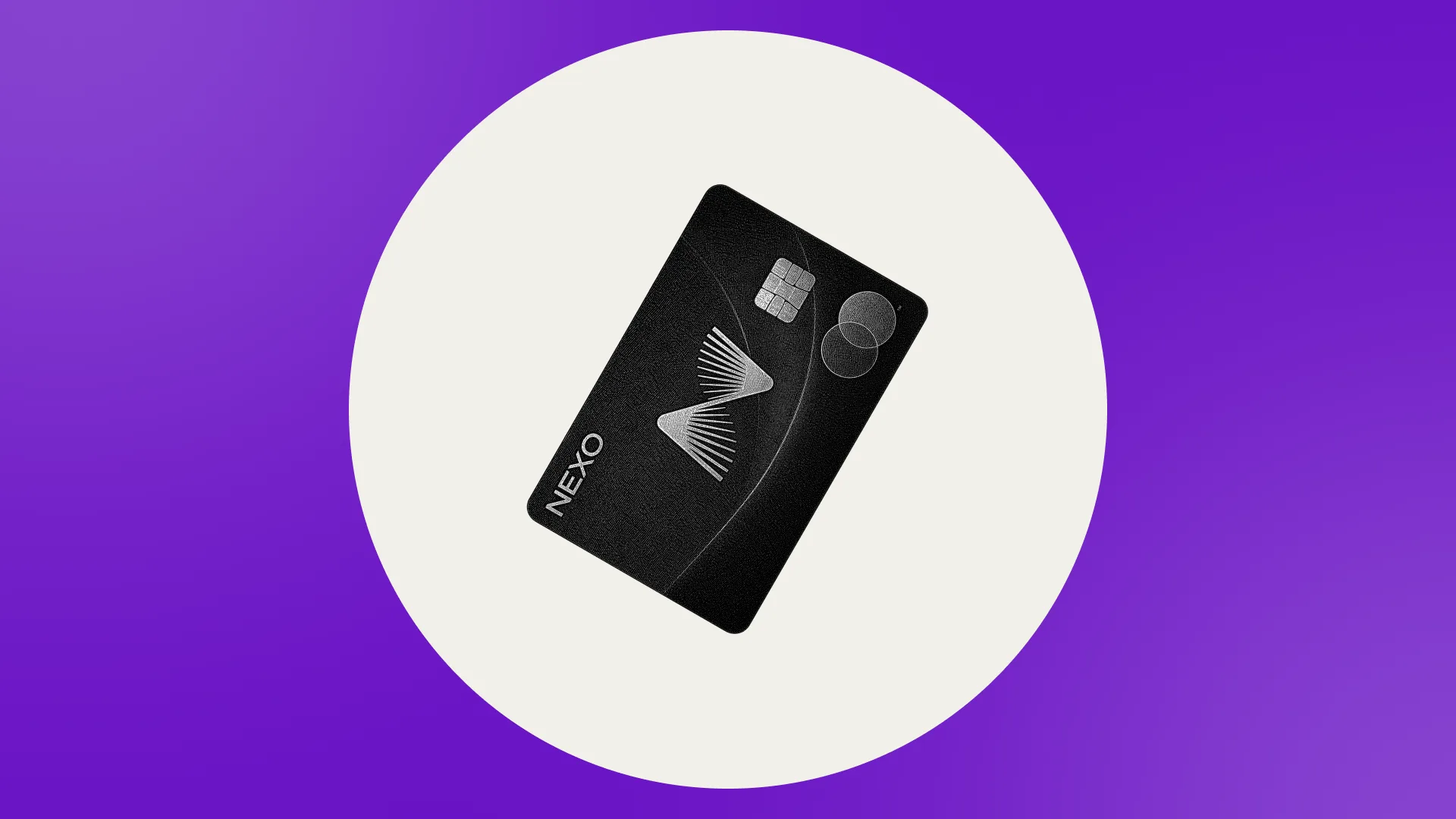
The Nexo Card is the most conceptually interesting card here. It runs two modes in one Mastercard: Debit Mode for spending from balances, and Credit Mode for borrowing against your crypto, and that dual-mode setup is the main reason to consider it. Spending on the credit line means you borrow rather than sell, which can defer a taxable disposal.
Rewards are real but gated. The Nexo Card offers 0.5%–2% NEXO cashback across four tiers: Base (0.5%), Silver (0.7%), Gold (1%), and Platinum (2%). The catch: the minimum $5,000 portfolio is required for any cashback eligibility, and cashback is earned only in Credit Mode, debit purchases earn nothing. Fees are light, no monthly or annual card fees, with a roughly 1.35% FX markup on non-settlement spend.
Two honest caveats: the card is available only in selected European countries, physical card orders have been paused since January 2025, and the best rewards require holding NEXO as at least 10% of your portfolio. And UK cardholders cannot earn cashback due to a regulatory phase-out, though the card still works for spending. Borrowing against collateral also carries liquidation risk if your crypto's value falls below the loan-to-value threshold.
Best for: EEA long-term HODLers who want liquidity without selling and understand collateral risk.
Deciding between staking for CRO rewards and borrowing against your stack with Nexo? Compare these two side by side →
Wirex Card – Best Multi-Currency Card for Travel
Wirex is a veteran multi-currency card that folds fiat, stablecoin, and crypto balances into one app. It runs on Visa or Mastercard depending on your region, is available in the UK, most EEA markets, and select APAC countries including Australia and New Zealand, has no annual fee, and supports Apple Pay and Google Pay. Its biggest travel advantage is genuine: as a direct Visa principal member, not issued through a third-party banking partner, Wirex offers genuine 0% FX fees on all currencies.
The rewards ceiling, however, is largely aspirational. Wirex advertises up to 8% cashback, but that rate requires locking 7.5 million WXT tokens, and the free Standard plan offers 0.5% Cryptoback in WXT with an approximately $200 monthly free ATM allowance before a 2% fee, supporting 30+ assets across 35 countries. Treat the higher tiers as a subscription product, since the top plan can cost up to €29.99 per month.
For readers weighing Wirex against a mainstream fintech card such as Revolut, the deciding factor is usually whether you genuinely want crypto balances in the mix; if not, a standard multi-currency card may be simpler.
Best for: frequent international travellers and digital nomads who hold multiple fiat and crypto currencies and value zero FX above headline cashback.
Want a travel card with verified 0% FX across every currency? View card →
BitPay Card – Best-Known US Option, but Currently Waitlisted
BitPay is one of the longest-established names in crypto payments, and its card is a US-only prepaid Mastercard that converts crypto or USDC into spendable dollars. The terms for existing holders are clean: no annual fee, no monthly fee, a $10,000 daily purchase limit, and merchant cash-back offers that can reach 15%, but there is no base reward on everyday spend, and a 3% foreign transaction fee makes this a poor choice for travel. It supports BTC, ETH, USDC, and USDT, with Apple Pay and Google Pay.
The overriding caveat is access. As of 2026, BitPay has temporarily paused new applications; existing cardholders can still use their cards, and new users can join a waitlist. That pause has run for an unusually long stretch, and a relaunch is not guaranteed to arrive with competitive terms.
Best for: existing US BitPay holders who want no-frills load-and-spend simplicity. New applicants realistically cannot get this card right now and should compare active US-available alternatives instead.
Bybit Card – Best High-Cashback Card for Active Traders
The Bybit Card pairs a strong reward ceiling with transparent fees. It is a Mastercard debit card available in EEA, Switzerland, Australia, and a handful of other regional programs; it runs off your Bybit Funding Account, uses fiat first at checkout, and converts selected crypto automatically if your balance runs short. Rewards are tiered, cashback ranges from 2% (base) to 10% (top tier), paid out in USDT, with the virtual card free and the physical card a one-time $5.
What lifts it above the pure-headline crowd is the fee clarity and the perks. FX (0.5%) and crypto conversion (0.9%) fees are clearly disclosed rather than hidden in spreads. Subscription rebates add real value for regular spenders: at Tier 2 or above, roughly $35 a month of Netflix and Spotify can be fully rebated.
The limits are worth knowing before you count on the top rate, monthly cashback caps rise with tier, and lower tiers are capped tightly. It is also not currently available in the US, Singapore, or Hong Kong.
Best for: active Bybit traders in supported regions who will reach the higher VIP tiers and want cashback stacked with subscription rebates.
OKX Card – Best for Stablecoin Spenders in the EU
The OKX Card is the cleanest stablecoin-spending option in this list. It is a Mastercard debit card available across the EEA (EU plus Norway, excluding Iceland and Liechtenstein), virtual-first, with zero transaction fee, zero FX fee, only a 0.1% market spread on stablecoin-to-fiat conversion, and no annual or inactivity fee. Because you spend stablecoins, each swipe generates little taxable gain compared with spending volatile assets.
Rewards are competitive but come with a firm condition. Ongoing rates apply only to USDG-funded transactions, USDC and USDT spending earns 0%, and tier qualification is your OKX exchange VIP level, based on asset balance or 30-day trading volume, whichever is higher. There are four tiers: Regular (2%), VIP 1 (4%), VIP 2 (4.5%), and VIP 3+ (5%), with USD monthly caps of $5, $100, $200, and $800 respectively. A notable plus over token-staking rivals: OKX Card does not require you to stake or lock a native token to earn cashback.
Best for: EEA users who keep balances in stablecoins and want near-zero spending costs; the higher reward tiers reward existing high-volume OKX traders.
5. Best Crypto Cards for Travel in 2026
For travel, the number that matters most is the foreign transaction fee, because it applies to every purchase abroad. On that measure, the Wirex and OKX cards lead this roundup, Wirex through its direct-Visa-member 0% FX, and OKX through its zero FX fee plus a tiny 0.1% spread. Both undercut the 3% FX charged on the BitPay Card and Crypto.com's lower tiers, and the 2.49% Coinbase debit FX fee.
Three practical travel rules:
- Check ATM allowances. Many cards give a small monthly free withdrawal cap, then charge a percentage. On Wirex Standard, for example, the free allowance is roughly $200/month before a 2% fee.
- Favour stablecoin funding abroad. Paying with USDC or USDG avoids both volatility and, in many jurisdictions, a taxable gain on every purchase.
- Confirm availability in your destination and residence. These cards are issued by residence, not by where you're travelling, so a card you can't hold at home won't help on the road.
A crypto card is a genuinely useful travel tool, but a plain multi-currency fintech card with 0% FX can serve the same purpose without the tax admin, so weigh whether you actually want crypto in the loop.
6. How to Maximise Crypto Cashback Without Overpaying
Headline cashback rates are almost never the rate you earn. To close the gap between advertised and realised rewards:
- Read the cap, not just the rate. A 10% rate on a $50/month cap returns at most $5. Bybit's and OKX's lower tiers illustrate how tightly caps can bind.
- Price in the token you're paid in. Rewards land in CRO, WXT, NEXO, BNB, USDT, or USDG. Stablecoin rewards (USDT, USDG) hold their value; token rewards can appreciate or fall sharply, so a "5%" rate is only 5% if the token holds.
- Count the cost of unlocking the tier. Wirex's 8% needs a €29.99/month plan plus a large WXT lockup; Crypto.com's best rates need CRO staked for 12 months. Divide the annual cost by your expected spend before chasing the top tier.
- Watch the spread and FX. A 3% cashback rate paired with a 3% FX fee nets you nothing abroad.
The cleanest high-value setups in 2026 tend to be stablecoin-funded cards with modest but genuinely-earned rates and near-zero fees, rather than volatile-token cards with eye-catching ceilings.
7. How to Choose a Crypto Card: A Buyer's Guide
Work through these questions in order:
- Where do you live? Availability eliminates most options immediately. US readers face a very different shortlist (Coinbase, and a waitlisted BitPay) from EEA readers (OKX, Nexo, Bybit, Wirex).
- Which exchange do you already use? Exchange-linked cards (Coinbase, Bybit, OKX, Binance) are simplest if you already hold assets there.
- Do you want to spend crypto, or borrow against it? Nexo's Credit Mode is the standout for holders who don't want to sell.
- Stablecoin or volatile funding? Stablecoin cards (OKX) minimise both volatility and tax friction; volatile-asset cards maximise upside and admin.
- What's your real monthly spend? This determines whether tier caps and plan fees make sense.
- Custodial or self-custody? Every card in this roundup is custodial or exchange-linked; readers who want to spend from a self-custody wallet should compare that category specifically.
8. Tax and Security Considerations
Two points that catch new users out. First, tax: in many countries, spending a volatile crypto asset is a disposal that may trigger capital gains, and each swipe is a separate event to record. As one review of OKX notes, every card transaction is a taxable disposal of crypto, with IRS Form 1099-DA reporting starting from the 2025 tax year in the US. Stablecoin spending sharply reduces this burden. This is general information, not tax advice, check the rules in your jurisdiction.
Second, security: all these cards require full identity verification (KYC), support in-app freezing and spend controls, and add to Apple Pay and Google Pay for tokenised payments. Custodial cards mean the issuer holds your funding balance, so counterparty risk sits with the exchange, a reason to keep only spending-money on the card rather than your whole portfolio.
Ready to line up the two highest-cashback cards in this roundup on one screen? Compare cards →
Key Takeaways
- No single card wins for everyone. The right choice is decided first by your country, then by the exchange you use and the assets you hold.
- For high cashback: the Bybit Card (2%–10% in USDT) and Wirex Card (up to 8% in WXT) lead, but both gate the top rate behind tiers or plans.
- For low-cost stablecoin spending: the OKX Card's 0% FX and 0.1% spread are hard to beat in the EEA.
- For borrowing instead of selling: the Nexo Card's dual-mode Mastercard suits long-term EU holders.
- For US readers: the Coinbase Card (or Coinbase One credit card) is the practical pick, since the BitPay Card remains waitlisted.
- Read the fine print: caps, plan fees, FX charges, and reward-token volatility routinely shrink the headline rate.
Availability, fees, and reward rates change on issuer refresh, so confirm the current terms for your country before applying. The most efficient next step is to filter by your region and preferred assets on the crypto cards comparison page.
Frequently Asked Questions
What is the best crypto card in August 2026?
There isn't one objective best. On cashback ceiling, the Bybit Card (up to 10% in USDT) and Wirex Card (up to 8% in WXT) lead; on low-cost stablecoin spending, the OKX Card's 0% FX and 0.1% spread stand out; and for US users, the Coinbase Card is the most practical. The right pick depends on your country, your exchange, and whether you fund with stablecoins or volatile assets.
Do crypto cards charge foreign transaction fees?
It varies widely. The OKX Card charges zero FX fee with only a 0.1% market spread, and Wirex advertises 0% FX as a direct Visa member. At the other end, the BitPay Card charges a 3% foreign transaction fee, and Crypto.com's lower tiers also apply a 3% FX charge. Always check the tier you'll actually be on.
Can I get a crypto card in the United States?
Options are more limited than in Europe. The Coinbase Card (Visa debit) and Coinbase One Card (Amex credit) are available to US users, and OKX operates in 40+ US states following its DOJ settlement. However, the BitPay Card is currently paused for new US applications, and both the Binance Card and the Crypto.com prepaid card are unavailable to US residents.
Are crypto card rewards taxable?
In many jurisdictions, spending a volatile cryptocurrency is a taxable disposal, and the rewards you earn may also be taxable as income when received. Card transactions can count as taxable disposals, with new reporting requirements phasing in. Funding with stablecoins reduces the gain calculation on each purchase. This is general information, consult a tax professional for your situation.
Why do rewards paid in tokens vary so much in value?
Because rewards land in a specific asset, CRO, WXT, NEXO, BNB, USDT, or USDG, and non-stablecoin tokens fluctuate in market value. A "5% cashback" rate paid in a volatile token is only worth 5% if that token holds its price; it can be worth more or less by the time you sell. Rewards paid in stablecoins such as USDT or USDG hold their value against the dollar.
What's the difference between a crypto debit card and a crypto credit card?
A crypto debit card spends from a balance you already hold, either a pre-loaded fiat balance or crypto converted in real time. A crypto credit card, such as the Coinbase One Card or Nexo's Credit Mode, lets you borrow (against crypto collateral or a revolving line) and pay later, which can defer selling your assets. The Nexo Card's dual-mode design lets you choose between spending your crypto balance or using your credit line for each transaction.