


Blackcatcard
#134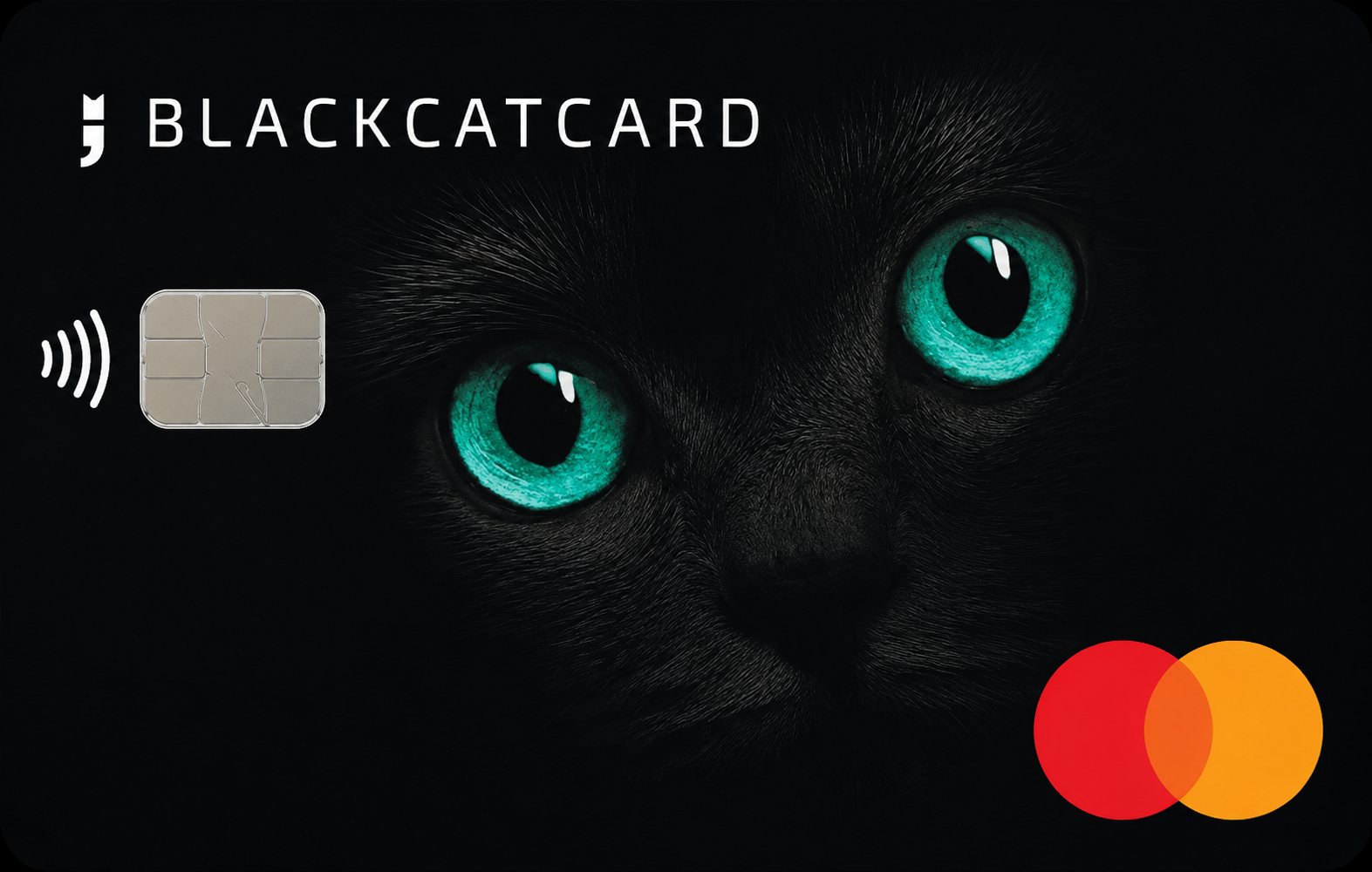
A no-monthly-fee Euro debit card with modest cashback options and a personal IBAN, but a steep 3% FX fee and custodial crypto holding make it a narrow fit for EUR-spending Europeans only.
Get BlackcatcardAvailability
Rewards rate
Up to 0.5%
FX fee
3%
Savings
0.0
Availability
30 countries
BlackcatcardMain perks
Bonus offers
Rewards
Pros
Cons
Options to Blackcatcard




FAQs
Questions, answered
Blackcatcard is a euro e-money account with a personal IBAN, Mastercard payment cards, SEPA transfers, cashback programmes and an integrated crypto service. The account is issued by Papaya Ltd, a Maltese Electronic Money Institution regulated by the Malta Financial Services Authority.
Eligible users receive a virtual Mastercard as part of the standard account package and can also order a physical card. The card spends the euro balance held in the Blackcatcard account rather than automatically deducting cryptocurrency at the merchant.
The crypto section sits alongside the euro account and currently supports buying, selling, storing, sending and receiving BTC, ETH and USDT through a separate partner. This makes Blackcatcard closer to an e-money account with integrated crypto functionality than to a pure crypto exchange card.
No. Blackcatcard is not a bank. The account and card are issued by Papaya Ltd, which is authorised as an Electronic Money Institution by the Malta Financial Services Authority under registration number C55146.
This means customer euro funds are held under e-money safeguarding rules rather than as conventional bank deposits. Blackcatcard explicitly states that money held in its e-money accounts is not covered by a depositor compensation scheme.
For everyday users, the account can still look similar to a bank account because it includes a euro IBAN, SEPA transfers, cards and account-management features. The legal protection model is different, however, so users should not describe the balance as a normal insured bank deposit.
Blackcatcard is issued by Papaya Ltd. Papaya is authorised and regulated by the Malta Financial Services Authority as an Electronic Money Institution, with registration number C55146.
Papaya is responsible for the e-money account and Mastercard payment-card infrastructure. Blackcatcard's crypto service is separate and is provided through MANERIO Sp. z o.o., which handles the integrated crypto functions available in the app.
This distinction matters because the card issuer and the crypto-service provider are not the same entity. If a problem concerns a euro card payment or IBAN transfer, Papaya's payment framework applies. If it concerns crypto buying, selling or wallet activity, the relevant crypto partner's terms can also be involved.
No. Blackcatcard's crypto service is custodial rather than self-custodial. The integrated service lets users buy, sell, store, send and receive crypto inside the Blackcatcard app, but the wallet infrastructure is provided by a third-party crypto partner rather than by a wallet where the user controls private keys directly.
Blackcatcard's current Help Centre identifies MANERIO Sp. z o.o. as the crypto-service provider. The euro account and Mastercard are separately issued through Papaya Ltd.
This makes Blackcatcard convenient for users who want euro banking-style features and crypto in one app, but it is not designed for users whose main requirement is direct private-key control. For self-custody, you would need to move eligible crypto to an external wallet that you control.
Blackcatcard's current consumer crypto service supports three main cryptocurrencies: Bitcoin, Ethereum and Tether USDT.
Users can buy, sell, store, send and receive these assets from the crypto section of the mobile app. Blackcatcard also supports internal crypto transfers between Blackcatcard users and external transfers to other wallets, subject to the crypto service's eligibility rules and transaction limits.
The supported crypto list is much narrower than on a large exchange, so Blackcatcard is better suited to users focused on BTC, ETH and USDT than to people who want access to hundreds of tokens. The crypto section is available only in the mobile app and is restricted in some countries.
The Blackcatcard Mastercard spends from the euro e-money account, not directly from a crypto wallet at the merchant. If you hold BTC, ETH or USDT in the integrated crypto service, you generally need to convert or sell the crypto into euros before that value becomes available for ordinary card spending.
This separation keeps card payments conventional: the merchant receives a Mastercard payment in fiat rather than cryptocurrency.
Blackcatcard still makes crypto-to-fiat access relatively convenient because the crypto service and euro account are available inside the same app. However, it is not the same model as a card that automatically sells crypto at the exact moment of purchase or debits a self-custodial wallet directly.
The standard personal Blackcatcard package currently includes one euro IBAN account and one Mastercard with no monthly maintenance fee. Additional cards increase the monthly account fee to €2, and an additional card currently costs €7.
The first five outgoing SEPA transfers each month are free, then Blackcatcard charges €0.20 per transfer. Card top-ups and card transfers carry a 3% fee under the current pricing page.
A significant cost to watch is inactivity. Blackcatcard currently charges €15 per month starting from the seventh month of inactivity. ATM withdrawals in the EU are free up to €200 per month, then cost 1%. Pricing can change, so users should check the current fee page before relying on these figures.
Blackcatcard currently lets users choose from several bonus programmes rather than stacking every cashback offer at once. The standard card-purchase programme pays 0.5% cashback on eligible card purchases, with a maximum monthly payout of €100.
Other current options include 2% cashback on Amazon purchases and 5% cashback at Google Play, each with its own conditions and payout rules. Blackcatcard also offers an account-balance reward programme of up to 4% per year, but this is a separate loyalty reward and is not described as bank interest.
Only one bonus programme can generally be active at a time, so users should choose the option that best matches their spending rather than adding the percentages together.
Yes. The physical Blackcatcard can be used for ATM withdrawals.
Within the EU, Blackcatcard currently charges no withdrawal fee on the first €200 withdrawn each month. After that allowance, the fee is 1% of the withdrawal amount. Outside the EU, the published fee is 1% with a minimum of €1.50.
The current daily ATM withdrawal limit is €5,000 and the monthly limit is €10,000. An ATM operator can still impose its own surcharge or currency conversion. Having multiple cards does not automatically multiply the account's overall cash-withdrawal ceiling, so users planning unusually large cash withdrawals should check the current limits in the app.
Blackcatcard's current legal terms support tokenised card use through digital wallets such as Apple Pay and Google Pay. The terms describe Mastercard tokenisation through the Mastercard Digital Enablement Service and transactions authenticated through the user's device.
Digital-wallet availability can still depend on the exact card, device and country. Because Blackcatcard issues both virtual and physical cards, users should confirm that the wallet option appears for their particular card before relying on mobile payments.
Adding the card to a digital wallet does not change the underlying euro balance, cashback programme or card limits. It simply provides another way to present the Mastercard credential for eligible online or contactless transactions.
Blackcatcard accounts are available from age 16, but payment-card eligibility is narrower than general account eligibility. To receive a Blackcatcard payment card, users must generally be at least 16 and provide proof of address in a supported EEA country.
The current card list includes countries such as Austria, Belgium, France, Germany, Italy, Spain, Portugal, the Netherlands, Poland, Ireland, Sweden and many other EEA markets.
People who are citizens of non-EEA countries but legally reside in the EEA can still qualify, although Blackcatcard may require a residence permit, long-term visa, refugee certificate or another official document proving the right to stay. Crypto-service eligibility is separate and starts at age 18.
Yes. The standard Blackcatcard personal account includes a euro IBAN that can be used for SEPA transfers.
Incoming SEPA transfers are currently free, and the first five outgoing SEPA transfers each month are also free. From the sixth outgoing transfer, Blackcatcard currently charges €0.20 per transfer.
The IBAN is part of an e-money account issued by Papaya Ltd rather than a traditional bank deposit account. That means the balance is safeguarded under e-money rules but is not covered by a depositor compensation scheme. For everyday use, however, the IBAN can support normal euro transfers alongside the Mastercard and crypto features available inside the same app.
Yes. Blackcatcard supports both virtual and physical Mastercard formats. The standard account package includes a virtual card, while eligible users can also obtain a plastic card and order additional cards.
Blackcatcard currently charges €7 for a standard additional card, and regular-mail delivery is free. The service also allows multiple additional cards and supports options such as custom nicknames on some cards.
The virtual and physical cards are connected to the same account environment. The physical card is needed for normal ATM withdrawals, while the virtual card is designed primarily for online and digital payments. Users who only need ecommerce spending may not need additional plastic, while households can use extra cards for separate spending needs.
Blackcatcard currently limits total external crypto transfers to the equivalent of €2,000 per day and €10,000 per month.
The integrated crypto service supports external transfers to other wallets as well as internal transfers between Blackcatcard customers. Internal transfers can be more convenient because they stay within the Blackcatcard ecosystem, while external transfers require wallet details and can be subject to blockchain and compliance checks.
The crypto-service limits are separate from card and ATM limits. For example, the Mastercard currently has a €5,000 daily and €10,000 monthly ATM withdrawal ceiling, but that does not increase the amount of crypto you can send externally. Users planning larger crypto transfers should check the live limits before moving funds into the service.
Blackcatcard provides 24/7 support through the official Support Chat available from its website and Help Centre. The main Help Centre is available at https://blackcatcard.com/help and covers cards, IBAN accounts, crypto, registration, cashback and security.
For card-payment issues, keep the merchant, amount, date and any decline or error message available. For crypto transfers, keep the asset, network, wallet address and transaction details ready so support can investigate the correct service.
Never share your account password, one-time authentication codes or wallet security credentials with someone contacting you unexpectedly. Because Blackcatcard uses different partners for e-money and crypto services, starting with the official Blackcatcard support channel is the safest way to route the issue to the correct provider.