

Bybit Card
#147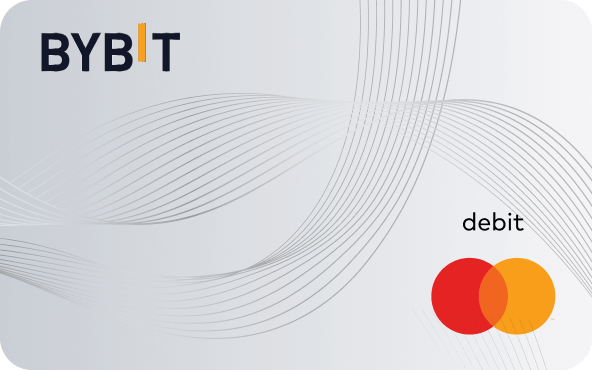
Bybit Card is a fee-light Mastercard debit card backed by a major exchange, with low FX and a high ATM limit. The headline 10% cashback needs heavy trading or spend, most users get a tightly-capped 2%, and funds stay custodial.
Get Bybit CardAvailability
Rewards rate
Up to 10%
FX fee
0.5%
Savings
0
Availability
32 countries
Bybit CardMain perks
Bonus offers
Rewards
Pros
Cons
Options to Bybit Card



FAQs
Questions, answered
The Bybit Card is a payment card linked directly to your Bybit Funding Account. It lets eligible users spend fiat and supported cryptocurrencies at merchants on the card network without first transferring money to a separate card wallet.
The exact card type depends on the region. Bybit currently issues Mastercard prepaid cards in some markets and Mastercard credit cards in others, while its broader card programme also references Visa in selected regions.
Bybit offers virtual and physical cards where available. The main product advantage for existing Bybit users is that card spending connects directly to balances already held in the Funding Account, including supported crypto that can be automatically converted when fiat is insufficient.
Yes. The Bybit Card does not use a separate card wallet. Payments draw from your Bybit Funding Account and, where supported, eligible Flexible Easy Earn balances.
For a card transaction, Bybit first uses the card's base fiat currency available in the Funding Account. If that balance is not enough, Bybit follows the crypto payment priority you have configured and automatically converts enough supported crypto to cover the remaining amount.
This is one of the card's most useful features for existing Bybit users because funds do not need to be manually topped up to a separate prepaid balance before every purchase. You still need enough eligible fiat or selected crypto for the transaction to be approved.
Bybit first deducts the card's base fiat currency from your Funding Account. If there is not enough fiat, it automatically sells supported crypto according to the payment priority you set.
The conversion uses Bybit's One-Click Sell exchange rate plus the applicable crypto conversion fee. Bybit currently applies a minimum crypto conversion amount that depends on region, such as 1 USD, 5,000 ARS or 10 BRL.
You can change the order of the cryptocurrencies used for payment from the card dashboard. If the only crypto you hold is not selected as an eligible payment asset, the transaction can be declined even though your account has sufficient value overall.
No. The Bybit Card spends from assets held in your custodial Bybit account, primarily the Funding Account and supported Bybit balances.
Bybit controls the account infrastructure and automatically converts crypto when required for a card payment. You do not hold the private keys to the funds being used by the card in the way you would with a self-custodial wallet.
For users already keeping funds on Bybit, this makes card spending simple and tightly integrated with the exchange. For users who want to keep their crypto under their own private-key control until the moment of payment, the Bybit Card is structurally different from self-custodial crypto cards.
Bybit supports multiple cryptocurrencies for card payments and lets users customise the order in which they are used. Its current general FAQ lists a default priority including USDT, USDC, GRAM, BTC, ETH and XRP, although the exact supported list can vary by card programme and region.
You can add, remove or reorder payment assets from the card dashboard. If fiat is insufficient, Bybit follows that priority and converts the first eligible crypto balance available.
A cryptocurrency being tradable on Bybit does not automatically mean it is enabled for card spending. Check the Pay With settings for your own card before relying on a particular token.
Bybit's current loyalty programme offers cashback rates from 2% up to 10% depending on tier or VIP level. Non-VIP users start at a base 2% rate and can unlock higher tiers through monthly spending, while eligible VIP users can receive higher rates directly from their VIP status.
The current tiers rise to 4%, 6%, 8% and 10%, each with its own monthly reward cap. Card and Bybit Pay spending are combined for tier calculations.
Rewards are earned as Bybit Points. Users can redeem points in the Rewards Market or enable Auto Cashback, which converts eligible points into a selected token and credits the cashback to the Funding Account.
Bybit Card fees vary significantly by region. Virtual-card issuance is currently free until further notice, while physical-card issuance can range from free to around 29.99 USD or USDT depending on the market and VIP status.
Crypto-funded transactions can carry a conversion fee. Bybit's current schedule lists 0.9% in several regions and 0.5% in Argentina, while Peru does not currently support crypto conversion. Foreign-exchange fees also vary, with examples ranging from 1% to 7% depending on the card programme.
ATM withdrawals commonly carry a 2% Bybit fee after a monthly fee-free allowance. Always check the fee table for your specific card region rather than applying one global rate.
Bybit Card spending limits depend on where the card was issued. There is no single global daily or monthly limit.
For example, the current Asia-Pacific programme lists limits of $10,000 per transaction and per day, $50,000 per month and $150,000 per year. Australia currently lists $13,500 per transaction and per day, $27,000 per month and $270,000 per year. Other regions use different local-currency limits.
Some card programmes let eligible users request a limit increase from the card dashboard. Virtual and physical cards can either share limits or have separate limits depending on region, so check the live Limits section for your own card.
Yes, where ATM withdrawals are supported by the relevant physical-card programme. Bybit's current fee schedule commonly waives its own ATM withdrawal fee on an initial monthly allowance and then charges 2% above that allowance.
For example, several regions receive the first $100 equivalent of monthly withdrawals without a Bybit ATM fee. The exact allowance and withdrawal limits vary by programme and currency.
The ATM operator can charge an additional access fee and may offer dynamic currency conversion. Those costs are outside Bybit's control. ATM withdrawals are also restricted in some locations, including Mainland China under the current card guidance.
Yes in many regions, but support depends on the specific Bybit Card programme. Google Pay is currently available for cards in markets including Argentina, Brazil, AIFC, Asia-Pacific and several other programmes, while Apple Pay is supported in selected markets such as Argentina, Australia, Brazil and Peru.
Mexico currently does not support either wallet under Bybit's published regional table. Samsung Pay is also available for some programmes.
The wallet must also be available in your country and on your device. Check the Card Management page in the Bybit app for the wallet options attached to your specific card rather than assuming every Bybit Card has the same compatibility.
Bybit Card is available only in selected regions, and eligibility depends on the country tied to your identity verification. Current programmes include markets such as Argentina, Australia, Brazil, Georgia, Kazakhstan, Mexico, Peru and selected Asia-Pacific jurisdictions.
Applicants need a verified Bybit account and must complete the card application for their country of residence. If your country is not currently supported, Bybit can register your interest rather than issue a card immediately.
Physical-card availability can be narrower than virtual-card availability because of regulatory and delivery restrictions. Bybit currently notes that the physical card is not yet available in Peru, for example.
Yes. Bybit's current card FAQ says the card can derive funds from both the Funding Account and eligible Flexible Easy Earn balances.
This can reduce the need to manually redeem certain flexible savings balances before spending. The card still follows Bybit's payment logic, using available base fiat first and then supported crypto according to the payment priority configured for the account.
Availability can depend on the asset, card programme and Easy Earn product. Users should check which balances are currently recognised by their card before assuming every Earn product is spendable. Fixed-term or otherwise restricted products should not be treated as instantly available card funds.
Yes, in supported regions. Bybit offers a virtual card for online payments and a physical card for in-store contactless payments and other physical-card use cases.
The virtual card is currently issued without an issuance fee until further notice. Physical-card fees depend on region and VIP level, and physical delivery is not available everywhere the virtual card is offered.
Virtual and physical cards can either share one spending limit or have separate limits depending on the programme. Bybit's regional fee and limit page should therefore be checked before assuming that adding a physical card doubles the amount you can spend.
Log in to Bybit, go to Finance and then Card, and select Apply Now. Choose your country of residence and complete the card application and any required identity checks.
If the virtual card is supported for your region, it can be issued digitally after approval. The physical card is a separate application step in markets where delivery is available and may carry an issuance fee.
Before applying, review the current regional fee schedule, card type and wallet support. Bybit's card programme is not uniform worldwide, so users in different countries can receive different base currencies, fee structures and card features.
For card help, use Bybit's official Help Center at https://www.bybit.com/en/help-center and the support options available while signed in to your account. Bybit provides dedicated documentation for card transactions, fees, rewards, limits and card management.
For a payment issue, keep the merchant, amount, date and transaction status available. If a reward is missing, check whether the transaction is confirmed and eligible before contacting support because reward points can remain pending for several days.
Never share your password, two-factor authentication codes or other security credentials with someone contacting you unsolicited. Use only official Bybit channels for account-specific card support.