


BitMart Card
#19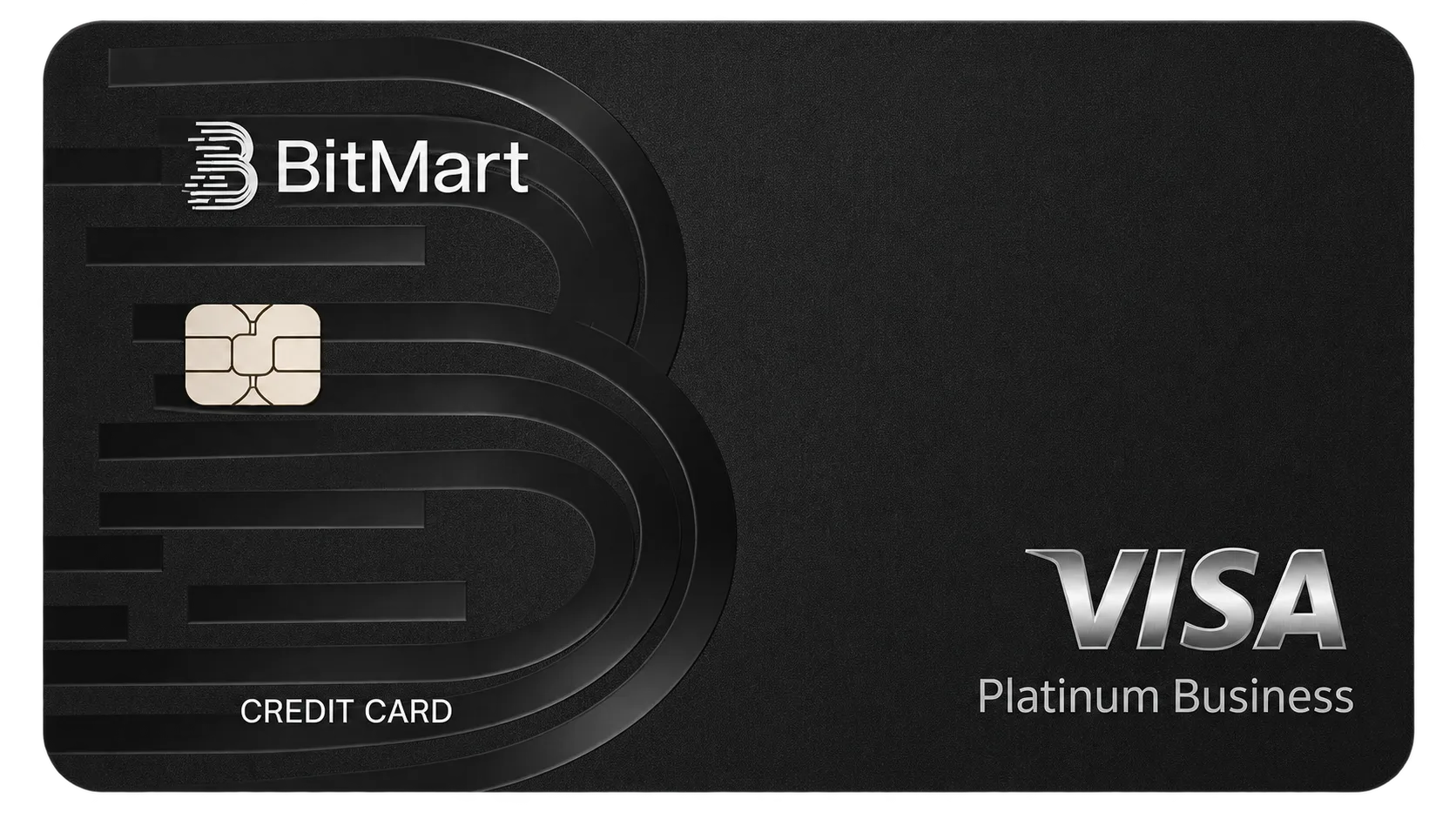
The BitMart plastic card costs $70 to apply for with no annual fee, raising the daily limit to $50,000 and adding ATM access at 2%. It spends from your exchange balance across twelve cryptocurrencies with cashback up to 5.5% on groceries and dining. The catch: every transaction carries a 1.3% fee on top.
Get BitMart CardAvailability
Rewards rate
Up to 5.5%
FX fee
—
Savings
None
Availability
Coming soon
BitMart CardMain perks
Bonus offers
Rewards
Pros
Cons
Options to BitMart Card



FAQs
Questions, answered
The BitMart Card is a physical plastic Visa card linked to a BitMart account. It allows eligible users to spend supported crypto balances at merchants that accept Visa, with BitMart converting the required account balance into USD when a purchase is made.
BitMart offers three main card formats within the programme: a free virtual card, the standard plastic BitMart Card and the premium metal Platinum Card. The standard physical card currently costs $70 for regular users and has no annual fee.
The card is aimed at users who already keep assets on BitMart and want a direct route from their exchange balance to everyday payments and ATM withdrawals. It is not a self-custodial card, because the spending balance remains within the BitMart account and payment conversion is handled by BitMart and its card partners.
The BitMart Card draws on supported assets held in your BitMart account. When you make a card purchase, BitMart converts the required balance into USD in real time and settles the payment through Visa.
BitMart's current guide identifies USDT as the main supported spending asset. Users can view the payment-currency deduction order inside the card interface, and BitMart has announced plans to add more cryptocurrencies over time.
The virtual card is activated automatically after approval, while the physical plastic card must be activated once it arrives. Because the card spends from an exchange account rather than a separate self-custodial wallet, you need a sufficient BitMart balance for payments to succeed. This makes the card convenient for active BitMart users, but it also means access to spending depends on the status and availability of the BitMart account.
No. The standard BitMart Card spends from assets held in your BitMart exchange account, so it uses a custodial account model rather than a self-custodial wallet.
When you pay, BitMart converts the supported account balance into USD for the Visa transaction. You are therefore relying on BitMart and its payment infrastructure to hold the relevant account assets and process the conversion.
This is different from crypto cards connected directly to self-custodial wallets where the user retains control of the underlying wallet keys. The BitMart approach can be simpler for people who already trade and hold assets on the exchange because no separate wallet is needed for card spending. The trade-off is that you do not retain direct private-key control over the balance used by the card. If self-custody is a priority, this distinction should be considered alongside fees and cashback.
BitMart's user guide calls the product a multi-currency crypto debit card, while its FAQ says it functions like a credit card in presentation but requires a sufficient cryptocurrency balance in the BitMart account for every payment.
In practical terms, users are not receiving a normal unsecured credit line that can be spent first and repaid later. The card relies on the account balance available to support the transaction.
For comparison purposes, it is more useful to think of the BitMart Card as a balance-backed crypto spending card using Visa infrastructure. The word 'credit' in some BitMart materials should not be interpreted as meaning you receive conventional revolving consumer credit. Users should focus on the supported balance, conversion fee and card limits rather than expecting a monthly interest-bearing credit statement.
The standard physical BitMart Card currently costs $70 to issue or replace for regular users. It is made from plastic and has no annual fee, inactivity fee or cancellation fee under BitMart's published fee schedule.
VIP members can reduce the upfront cost. BitMart currently provides the plastic card free to VIP 1 to 8 users under its card VIP benefits, while regular users pay the full $70.
This places the standard card between BitMart's free virtual card and the $120 metal Platinum Card. For users who need ATM access or a physical card but do not care about metal construction, the plastic version is the lower-cost physical option. The ongoing transaction fee is still important, because BitMart currently lists a 1.3% foreign-exchange or card transaction fee regardless of the lower issuance price.
BitMart currently lists a 1.3% foreign-exchange or card transaction fee for the standard BitMart Card. There is no annual fee, inactivity fee or cancellation fee. The physical plastic card costs $70 to issue or replace for regular users.
ATM withdrawals carry a 2% BitMart fee, although VIP users can receive monthly fee-free ATM allowances under the current VIP programme. The ATM operator may also impose its own surcharge.
These ongoing costs matter more than the one-time card price for frequent users. For example, a user spending heavily every month can pay more in the 1.3% transaction charge than in the initial $70 issuance fee. Cashback can offset part of that cost, but the applicable reward rate depends on category, campaign and VIP status. Check the live card page before assuming cashback always exceeds the transaction fee.
BitMart's standard cashback programme usually starts around 1% and can reach 3.5% for ordinary eligible transactions, with higher rates for selected categories and promotions. BitMart's current card page advertises 4% for online purchases during a new user's first month, then 3.5%, and 5.5% for groceries and restaurants in the first month, then 5%.
Limited campaigns can offer even higher temporary rates. BitMart's cashback FAQ says special promotions can reach 10%, while individual campaigns have gone beyond that for specific spending categories.
Cashback is generally credited to the user's BitMart Spot Account in USDT or another eligible reward asset. Some transactions are excluded, including ATM withdrawals, transfers, top-ups, cash advances and certain financial or gambling merchant categories. The relevant rate should therefore be checked at the time of purchase rather than treated as one permanent card-wide percentage.
BitMart's latest fees and limits page lists no fixed per-transaction, daily, monthly or annual purchase ceiling for the BitMart Card programme. The standard plastic card product page also advertises a $50,000 daily limit in some card comparisons, while the central fee table now shows spending as unlimited.
Because those official pages are not perfectly aligned, the live account and issuer controls should be treated as authoritative. Available BitMart balance, compliance reviews, merchant limits and Visa risk controls can all restrict an individual transaction.
For high-value purchases, do not rely only on the word 'unlimited' or an older $50,000 marketing figure. Check the limit displayed in your card dashboard and contact support if necessary. MyCardCompare treats the current central fee-and-limit page as the stronger source, while recognising that practical authorisation can still be lower.
Yes. The physical BitMart Card supports ATM withdrawals at compatible Visa ATMs. BitMart currently charges a 2% ATM withdrawal fee for standard users.
The published withdrawal limit is $2,000 per day and $20,000 per month, with a maximum of three ATM withdrawals per day and 30 per month. BitMart does not publish a yearly withdrawal amount cap in the current fee table.
VIP members can receive a monthly amount of fee-free ATM withdrawals, with higher allowances at higher VIP levels. This benefit relates to BitMart's fee and does not prevent the ATM owner from charging its own surcharge. If an ATM offers currency conversion, compare the rate carefully because the operator's dynamic currency conversion can add a separate cost on top of BitMart's card pricing.
Yes. BitMart supports Google Pay and has published official Apple Pay terms for eligible BitMart Cards. Users can add an eligible card to a compatible mobile wallet for contactless and online payments.
BitMart currently does not impose an additional card fee solely for Apple Pay use. The ordinary BitMart Card fees, conversion rules and account controls still apply to the underlying transaction.
Wallet support can vary by card, device and region. BitMart's earlier card guide highlighted Google Pay first, while later Apple Pay terms confirm Apple Pay enrolment for eligible cards. This is why users should follow the current in-app card instructions rather than relying on launch-era documentation. If enrolment fails, check that the card and underlying account are in good standing before contacting support.
BitMart's current user guide lists USDT as the supported spending asset for the BitMart Card. The platform has announced plans to expand support to assets such as BTC, ETH, BMX and USDC, and its broader marketing materials refer to a growing list of supported cryptocurrencies.
At checkout, the supported BitMart balance is converted into USD for settlement through Visa. This means a cryptocurrency being listed for trading on the BitMart exchange does not automatically mean it can fund a card payment.
Before relying on a specific token for spending, open the BitMart Card interface and check Payment Currency. That screen is more reliable than assuming every asset mentioned in marketing materials is already enabled for your account. If a token is unsupported, you may need to convert it to USDT or another currently accepted card asset first.
BitMart Card applications are open only in eligible regions. Applicants must complete BitMart Identity Verification Level 2 and may be asked for extra supporting documents as part of the card review.
BitMart publishes a list of restricted jurisdictions for card usage and can change application availability independently of the wider exchange. For example, it suspended new virtual-card applications in Bangladesh in June 2026.
The standard physical card also depends on delivery coverage and the issuer serving the applicant's country. This means an existing verified BitMart exchange account does not guarantee access to the plastic card. Check the BitMart Card section after KYC to see which card formats are actually available for your residence. Do not pay or upgrade solely for card benefits until physical-card eligibility is confirmed.
VIP status can make the standard physical BitMart Card significantly cheaper. Regular users currently pay $70 for the plastic card, while BitMart lists the standard BitMart Card as free for VIP 1 to 8 users.
VIP members can also receive higher cashback or rebate rates and larger fee-free ATM allowances. BitMart currently publishes cashback of up to 3% for VIP members in certain general spending scenarios, compared with a lower standard base rate, although category-specific campaigns can offer different rewards.
If you already qualify for BitMart VIP, these benefits can materially improve the card's economics. If you would need to trade more or hold assets solely to reach a VIP tier, calculate the cost of qualifying before valuing the free card or extra rewards. VIP thresholds and card benefits can change, so the current VIP page should be checked before applying.
Log in to your BitMart account, open Buy & Sell or Add Funds, choose BitMart Card and select Apply Now. Complete the application form, KYC Level 2 and any additional checks requested for your region.
Choose the standard plastic BitMart Card if it is available. Regular users currently pay $70, while eligible VIP members may receive the physical card without an issuance fee. BitMart says applying for a physical card also activates a virtual card.
The virtual card can be used after approval, while the plastic card needs to be delivered and activated through your account. Before paying, confirm the current shipping coverage and regional eligibility. Card access can be narrower than access to the BitMart exchange, and individual countries can be added to or removed from the application programme.
For BitMart Card support, use the official BitMart Help Center at https://www.bitmart.com/en-US/support and open the BitMart Card section. The Help Centre contains the current card FAQ, fees and limits, cashback rules, application guidance and programme notices.
For a specific payment, ATM or card-status issue, contact support while signed in so BitMart can identify the relevant account and transaction. Keep the merchant, amount, date and any error message available.
Do not share your account password, authenticator codes or one-time verification codes with anyone who contacts you claiming to be support. Apple Pay or Google Pay issues can involve both BitMart eligibility and the wallet provider, but the BitMart Help Centre is the best first point of contact for confirming whether the card itself is active and eligible.