


Solid Card
#33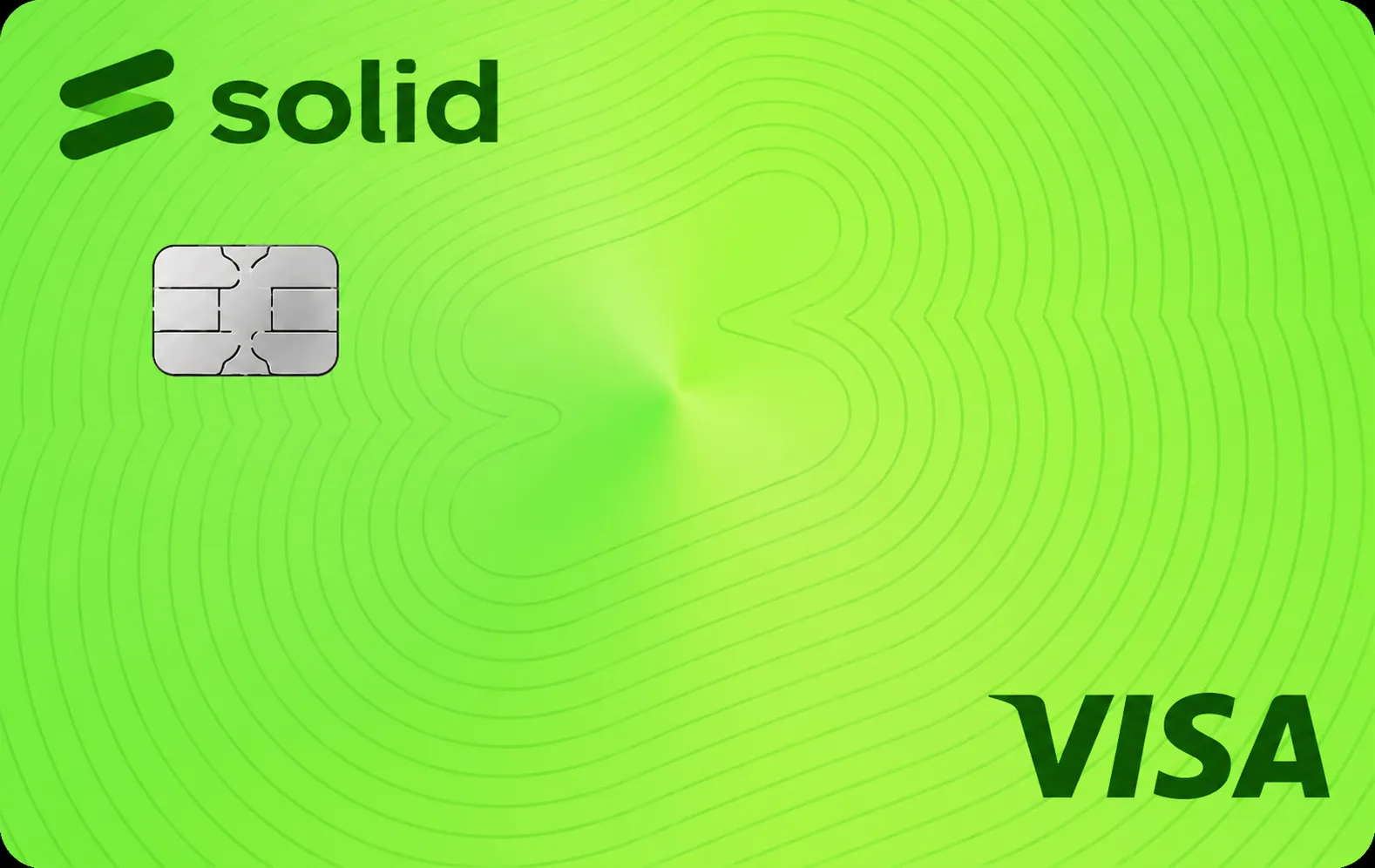
Solid is a self-custodial stablecoin app with a Visa credit card issued by Rain, paying up to 5% cashback while your balance earns yield in the background. Adding money is free, US dollar spending is free, and cross-border fees are absorbed by Solid. The catch: 1% on non-USD purchases, a 10% cut of your yield, and no published country list.
Get Solid CardAvailability
Rewards rate
Up to 5%
FX fee
1%
Savings
Up to 6%
Availability
Coming soon
Solid CardMain perks
Bonus offers
Rewards
Pros
Cons
Options to Solid Card


FAQs
Questions, answered
The Solid Card is a non-custodial Visa debit card connected to Solid, a stablecoin and DeFi app. It is designed to let users keep money in Solid's yield-bearing on-chain system and spend from that balance at ordinary Visa merchants.
The card is currently virtual and supports Apple Pay and Google Pay. Solid says it works at more than 200 million Visa merchants worldwide where the card programme is available.
The distinctive feature is that Solid combines card spending with a self-custodial yield-bearing balance rather than requiring users to move all funds into a conventional centralised exchange wallet first.
Yes. Solid explicitly describes the card and wider app as non-custodial. Users hold assets through self-custodial smart accounts rather than depositing everything into a conventional exchange-controlled wallet.
Solid says its account security combines Safe smart accounts with MPC-based vault protection and passkey-style access. The card itself still relies on regulated payment infrastructure, including Bridge and Visa, when a merchant transaction is processed.
Self-custody therefore applies to the underlying on-chain balance, while the payment layer still uses normal card partners. Users remain responsible for understanding wallet recovery and the risks of the DeFi strategies connected to their balance.
Users deposit USDC into Solid, where it is converted into SoUSD, a yield-bearing token representing a share of Solid's managed DeFi vault. The balance can continue earning while it remains in the Solid ecosystem.
The Solid Card then lets users spend against that available balance through Visa without manually selling crypto before every purchase. At the merchant, the transaction looks like a normal card payment.
The important distinction is that SoUSD is not a normal bank deposit. Its value is tied to the underlying DeFi vault and the strategies used to generate yield. Card convenience does not remove smart-contract, protocol or stablecoin risk.
SoUSD is Solid's yield-bearing stablecoin-like vault token. When users deposit USDC, they receive SoUSD representing their share of a vault that allocates capital across selected DeFi strategies.
SoUSD does not necessarily remain worth exactly $1 per token. Solid explains that its exchange rate changes as the vault earns yield, so over time one SoUSD can represent more than one dollar of underlying assets. That means users may receive fewer than one SoUSD for each USDC deposited while preserving the same dollar-equivalent value.
SoUSD is central to Solid's savings and card model because it allows unspent balance to remain invested while still being connected to everyday spending.
Solid's current card page advertises up to 3% crypto cashback on card spending. Earlier launch material described a 2% FUSE cashback rate, which indicates the rewards programme has evolved since launch.
Because Solid's newer product page is the more current source, users should check the live app for the exact rate and reward asset that applies to their account. Solid also has a points and referral-rewards layer, so not every reward should be treated as direct cash value.
For comparisons, use the rate shown in the current Solid Card interface rather than relying on an older launch article.
Solid markets variable yield on unspent stablecoin balances, but the headline rate has changed over time and across different product pages. The main Solid homepage currently highlights around 6% or more, while the dedicated Card page advertises rates that can reach higher levels.
The rate is not guaranteed. Solid explains that yield comes from curated DeFi strategies using vault infrastructure, so the return depends on market conditions and the strategies selected.
Users should treat the APY displayed in the live app as the current figure. Unlike a bank savings account, this is an on-chain DeFi product with smart-contract, stablecoin, liquidity and protocol risks.
Solid's current card page markets the card as having no standard card fees, but it does not publish a sufficiently detailed public schedule covering every possible transaction type such as ATM withdrawals, foreign exchange or card replacement.
That means users should not interpret the headline 'no fees' wording as proof that every third-party or network cost is always zero. Visa, Bridge, merchants, banks or blockchain networks can still introduce costs depending on the transaction.
Before using the card for travel, foreign-currency purchases or cash access, check the fee disclosure inside the Solid app. MyCardCompare does not recommend inventing exact fee figures that Solid has not clearly published.
Yes. Solid officially supports both Apple Pay and Google Pay for eligible cardholders. The card is currently positioned primarily as a virtual Visa card, so mobile-wallet support is the main route for using it at physical merchants.
After approval, users can add the Solid Card to a compatible phone or device and make contactless purchases where the mobile wallet and merchant are supported.
Using Apple Pay or Google Pay does not change the underlying Solid balance or yield mechanics. The transaction still draws from the same available card spending balance.
The current Solid Card programme is primarily virtual. Solid's launch material and product page describe users receiving a virtual Visa card that can be used online and added to Apple Pay or Google Pay for in-store contactless payments.
Solid has discussed future or premium card tiers, but users should not assume a physical card is broadly orderable unless that option appears in the live app for their region.
For most current users, the practical experience is therefore digital-first: instant virtual issuance plus mobile-wallet payments rather than waiting for plastic.
Solid Card availability depends on the countries supported by Solid and its card partners. At launch, Solid explicitly listed the United States, Latin America and Africa as initial markets, with other regions planned for later expansion.
Because the card relies on regulated Visa and Bridge infrastructure, users also need to pass identity and eligibility checks even though the underlying wallet is self-custodial.
Solid's geographic rollout has changed over time, so the live app should be treated as the final eligibility check. Do not transfer funds specifically for card use until the Card tab confirms that your country and account are supported.
Yes. Solid's card launch guidance says users need to complete an identity check before the card is issued. This is required by the regulated card and payment infrastructure even though the underlying Solid wallet is non-custodial.
The distinction is important. Self-custody describes who controls the on-chain balance, while KYC determines whether an individual is eligible to access the Visa card service.
Applicants should complete verification only through the official Solid app. A legitimate KYC process does not require the seed phrase or private keys that control a self-custodial wallet.
Solid says the card is built in partnership with Bridge and Visa, with Stripe also referenced in its card-launch infrastructure. The consumer-facing card is a Visa debit product, while Solid provides the self-custodial wallet and DeFi yield layer.
This means Solid itself should not be described as the Visa network or as a traditional bank issuer. The payment card depends on regulated partners for card processing and settlement.
Understanding that separation is useful because the legal protections and support route for a card transaction can differ from the risks attached to the on-chain Solid wallet and SoUSD vault.
Yes, that is one of Solid's main product ideas. Solid is designed so a user's balance can remain inside its yield-bearing DeFi system while still being connected to card spending.
You do not need to manually redeem SoUSD to a bank account before every purchase. The card draws from the available Solid balance when you spend, while the rest can continue participating in the yield strategy.
However, this does not eliminate DeFi risk. The available card balance still depends on the underlying vault, liquidity and product rules, so users should not treat yield-bearing funds as identical to cash held in an insured current account.
Open the Solid app, create the self-custodial account and complete the identity check required for card access. If the programme is available in your country, the Card section lets you activate or request the virtual Visa card.
Once issued, you can add the card to Apple Pay or Google Pay and begin spending from the eligible Solid balance. Users first need to fund Solid, typically with USDC, which is used within the SoUSD yield system.
If the Card tab is not available, join the current rollout or waitlist rather than sending funds to an unofficial third party promising access.
Solid's current card page highlights human support and directs users through the official Solid app and website for account and card assistance. For a transaction issue, use the support route inside the app so the team can identify the relevant account and card activity.
If the issue is on-chain, keep the transaction hash and network details available. If it concerns a merchant payment, keep the merchant, amount and date.
Never give anyone your wallet seed phrase, private key or passkey credentials. Solid is non-custodial, so legitimate support should not need the secrets that control your wallet.