


Pionex Card
#15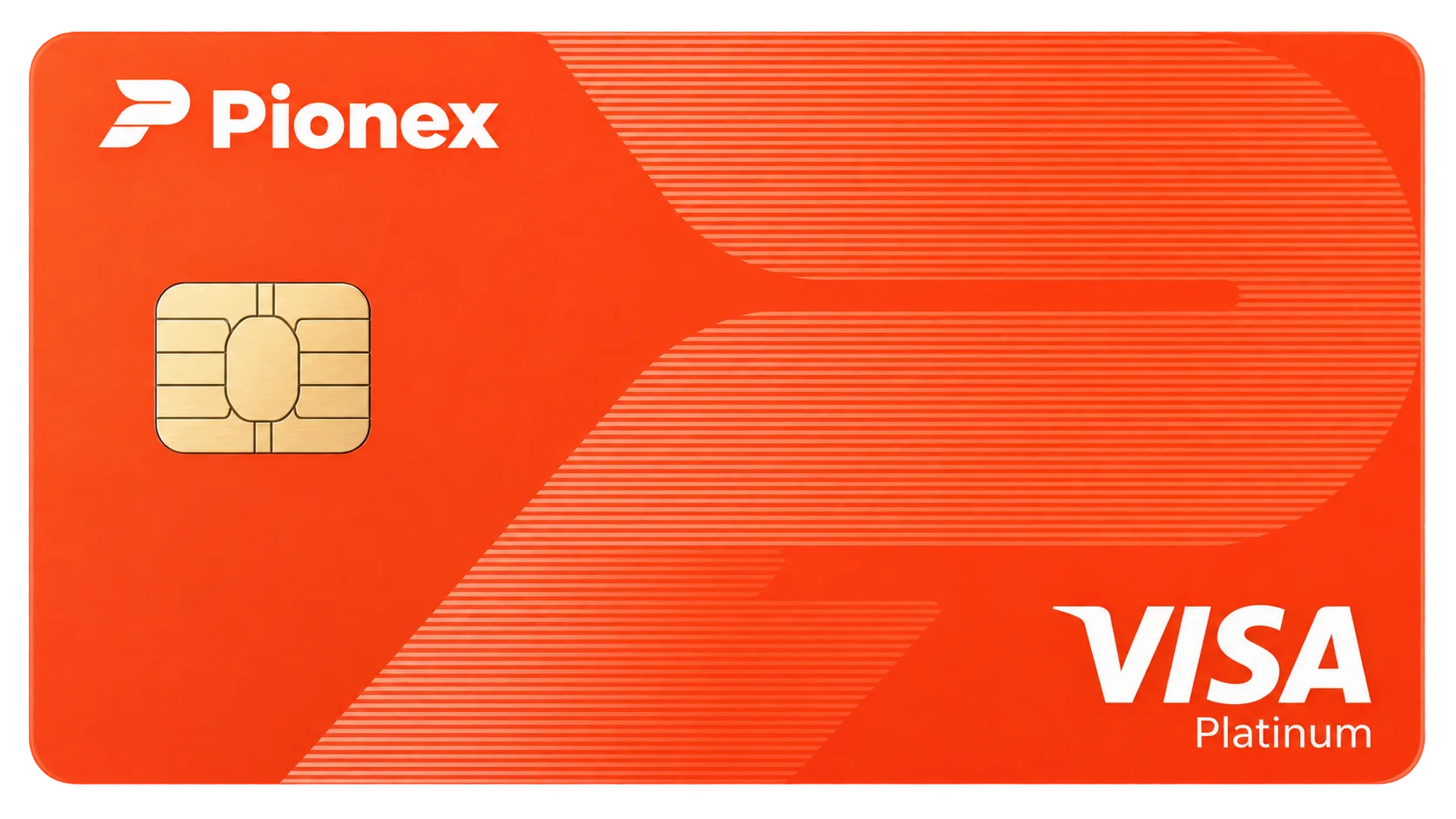
Pionex pairs its trading-bot exchange with a card carrying no issuance or annual fee, 1% cashback on everyday spending and up to 6% at partner merchants like Trip.com. Balances earn 5% through flexible earn, and it links to WeChat, Alipay, LINE Pay and PayPal. The catch: Pionex never states which card network it runs on, and publishes no FX or ATM fees.
Get Pionex CardAvailability
Rewards rate
Up to 6%
FX fee
—
Savings
5% flexible earn
Availability
Coming soon
Pionex CardMain perks
Bonus offers
Rewards
Pros
Cons
Options to Pionex Card




FAQs
Questions, answered
The Pionex Card is a crypto debit card that lets eligible users spend USDT through the Visa or Mastercard network. The card uses a separate Pionex Card account, so you first transfer USDT from your main Pionex account before making purchases.
The virtual card can be used online and, where supported, through mobile wallets for contactless payments. Pionex currently offers Visa and Mastercard variants, while physical cards remain limited rather than broadly available.
The Pionex Card is a cryptocurrency debit card, not a credit card. Pionex requires the card account to contain enough USDT before a purchase can be authorised.
There is no revolving credit line or interest-bearing card debt. Spending is limited by the balance available in the independent Card account and by the card's transaction limits.
Pionex currently supports USDT for the Card account. You transfer USDT from your main Pionex balance into the separate Card account, and purchases are funded from that balance.
Other cryptocurrencies supported by the exchange cannot currently be selected directly as the card's spending currency. If you hold another asset, you would need to convert it before moving value into the Card account.
Pionex currently advertises 1% cashback in USDT on eligible card purchases, with no standard monthly cashback cap or staking requirement.
Cashback does not apply to every transaction type. ATM withdrawals and excluded merchants or transaction categories do not qualify, so the final reward depends on the purchase meeting Pionex's cashback rules.
Pionex currently advertises 5% APR on eligible USDT held in the Card account. The balance continues earning while it remains available for spending.
This is separate from the 1% card cashback. Rates and eligibility can change, so users should check the current Card page before keeping a large balance solely for the advertised return.
Pionex lists no annual fee or inactivity fee for the Visa Card. USD and USDT spending uses a fixed 1:1 rate, while non-USD purchases carry a 1% transaction fee.
ATM withdrawals cost 2%. Small transactions of $1 or less and repeated failed payments can also trigger fixed fees after the monthly free allowance. These charges are separate from any ATM operator fee.
Both cards use the same USDT-funded Pionex Card account, but their pricing and limits differ. Pionex currently lists a 1% non-USD transaction fee for Visa and 2% for Mastercard, while the standard cashback rate remains 1% on eligible purchases.
Mastercard also has higher published purchase limits. For many users, Visa is the lower-cost option for foreign-currency spending, while Mastercard may appeal to users who need higher transaction capacity.
Pionex currently lists Visa limits of $10,000 per transaction and per day, with a $50,000 monthly purchase limit. Mastercard limits are higher, at $20,000 per transaction and per day and $100,000 per month.
Visa ATM limits are currently $3,000 per day and $7,000 per month. Pionex can review purchase-limit increases for some users, but ATM limits are not currently adjustable.
ATM withdrawals are supported for eligible physical Visa cards, but physical-card access is still limited and not the standard experience for most users.
Pionex currently charges 2% on ATM withdrawals, and the ATM operator can add its own surcharge. The published Visa ATM limits are $3,000 per day and $7,000 per month.
Yes. Pionex supports Apple Pay and Google Pay for eligible cards and regions. The Mastercard programme also supports services such as LINE Pay and PayPal.
This is important because the normal Pionex Card experience is virtual. Mobile-wallet support lets users make contactless in-store payments without needing a widely available physical card.
Pionex has a physical card programme, but access is currently limited rather than generally open to every eligible card user. Pionex's 2026 documentation describes physical cards as invitation-only.
Most users should expect to receive a virtual Visa or Mastercard and use it online or through a supported mobile wallet. Check the Card section in your account to see whether physical-card ordering is available.
Eligibility is checked individually inside Pionex. Users need a supported Pionex account, the required identity verification and an account balance of at least 100 USDT before applying.
Country availability is not universal. Pionex maintains a restricted registration and KYC list, and card approval is still separate even in countries where Pionex account verification is available. The Card page in the app is the final eligibility check.
No. The Pionex Card uses funds held within a Pionex account, so it is a custodial exchange card rather than a self-custodial card where only the user controls the private keys.
The separate Card account helps isolate spending funds from the main exchange balance, but the USDT still remains within Pionex's account infrastructure while available for card use.
Open the Pionex app, go to Wallet and then Card, and select Apply Now. Pionex automatically checks whether the account meets the current application requirements before asking for the cardholder details.
Eligible users can receive the virtual card after approval. You then transfer USDT from the main account into the separate Card account before making purchases.
For card, payment or account issues, use the official Pionex Help Center at https://support.pionex.com/hc/en-us. It includes dedicated Pionex Card articles covering applications, fees, mobile wallets and card management.
For an account-specific problem, contact customer service through Pionex's official support flow. Never share passwords, authentication codes or crypto withdrawal credentials with someone contacting you unexpectedly.