

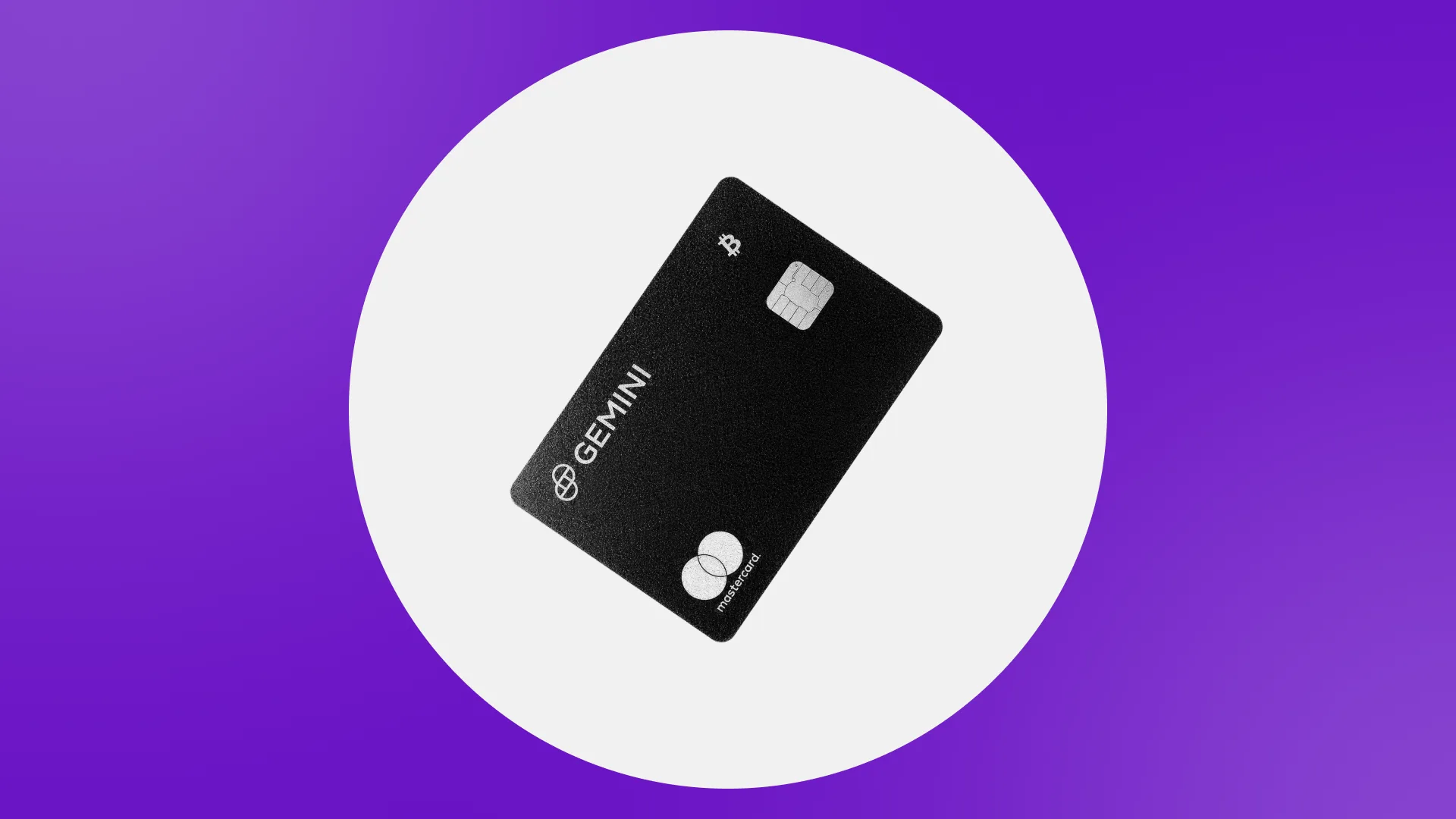
Gemini Card Review: Is This Crypto Rewards Credit Card Worth It in 2026?
The Gemini Credit Card earns up to 4% back in cryptocurrency on everyday purchases, charges $0 in annual and foreign transaction fees, and deposits rewards instantly into your Gemini exchange account. Its tiered structure pays 4% on gas/EV/transit/taxis/rideshare (capped at $300/month in spend), 3% on dining, 2% on groceries, and 1% on everything else. That puts it among the stronger no-annual-fee rewards cards in the U.S., crypto or otherwise. However, crypto rewards fluctuate in value after you earn them, the variable APR runs as high as 34.49%, and Gemini paused the introductory welcome bonus effective January 31, 2026. Keep in mind: this card is available in the U.S. only.
We compared the Gemini Credit Card against competing crypto and traditional cashback cards on MyCardCompare, looking at reward rates, fees, APR, and availability, to help you decide whether it belongs in your wallet.
The Gemini Card is one of 200+ cards compared on MyCardCompare, updated weekly. See how it stacks up. View card →
1. What Is the Gemini Credit Card and How Does It Work?
Card Basics at a Glance
The Gemini Credit Card is a WebBank-issued World Elite Mastercard that earns crypto rewards on everyday purchases. Rather than airline miles or traditional cash back, it rewards you in cryptocurrency, deposited into your linked Gemini account.
Key details:
- Annual fee: $0
- Foreign transaction fee: 0%
- Network: Mastercard (World Elite)
- Card material: Stainless steel metal card made from 75% recycled material
- Digital wallet support: Apple Pay, Google Pay, and Samsung Pay
- Availability: Available to residents of all 50 U.S. states and Puerto Rico; not available outside the U.S.
You must hold a Gemini exchange account to receive rewards. Non-registered users must also open a Gemini exchange account, as this is where the platform deposits cashback rewards.
How the Rewards Mechanism Works
The card runs on a revolving credit line, not a prepaid balance. Each purchase settles in U.S. dollars against that line, and you repay the balance from a linked bank account or by mailed check. Rewards arrive in the cryptocurrency you selected during setup, usually within the same transaction session, and deposit directly into your Gemini wallet.
You pick your reward coin when you apply, but you can switch it at any time inside the Gemini app. You can earn rewards in Bitcoin, Ethereum, or 50+ other cryptos currently available on Gemini.
Note: because rewards are denominated in cryptocurrency, their dollar value can rise or fall after you earn them. A 2% grocery reward today could be worth more, or less, by the time you sell.
2. Gemini Card Rewards Structure: Crypto-Back Rates and Earning Tiers
Earning Rates by Spending Category
Reward tiers: 4% on gas/EV/transit/taxis/rideshare (capped at $300/month), 3% on dining, 2% on groceries, 1% on everything else.
- 4% back: Gas, EV charging, transit, taxis, and rideshare, on up to $300 in spend per month (then 1% thereafter in that month).
- 3% back: Dining (restaurants and eligible food delivery), the 3% and 2% categories don't appear to have a cap as of 2026.
- 2% back: Groceries, no cap.
- 1% back: All other purchases, no cap.
There are no rotating categories to track or activate each quarter.
How Crypto Rewards Are Credited
The standout feature is timing: rewards are added instantly rather than waiting for the end of your statement cycle. The value is set at the moment of the transaction based on the current market price of your chosen asset.
This means your rewards gain or lose value with crypto market movements from the moment they land in your wallet. Under current U.S. guidance, receiving crypto rewards is treated as a non-taxable event. You earn crypto as a reward, which has a cost basis of $0 and is only taxed when you sell.
3. Fees and APR: What Does the Gemini Card Actually Cost?
Annual Fee and Standard Charges
Fee | Amount |
|---|---|
Annual fee | $0 |
Foreign transaction fee | 0% |
Cash advance fee | $10 or 3% (whichever is greater) |
Late payment fee | Up to $8 |
Returned payment fee | Up to $35 |
Gemini Card APR
The Gemini card has an APR of 18.49%–34.49% variable. Your specific rate is set at account opening based on creditworthiness. The cash advance APR is 29.49% variable, and the penalty APR is 33.49% variable, which can apply after late or returned payments.
For context, the average U.S. credit card APR has hovered around 20–22% in recent years, placing the Gemini card's low end in a typical range but its high end well above average.
The math is straightforward: carrying a balance destroys all reward value. At 34.49% APR on a $3,000 balance, you pay approximately $86/month in interest, wiping out the $49/month in rewards. This card only makes financial sense if you pay the statement balance in full every cycle.
4. Welcome Bonus and Sign-Up Offer
Does the Gemini Card Have a Welcome Bonus?
Effective January 31, 2026, at 11:59:59 PM Eastern Time, Gemini paused the introductory Bonus Crypto Reward offer for all Gemini Card products, including the Consumer Gemini Mastercard Credit Card.
The card's previous welcome offer paid new cardholders $200 in Bitcoin after meeting a spend threshold, but it was discontinued as of early 2026. There is currently no sign-up bonus to factor into first-year value calculations.
Gemini does maintain a referral program: $50 in crypto for each referral and an extra $250 bonus each time you make 5 referrals. This is an exchange-level program, not a credit card welcome offer.
How to Qualify for Any Available Promotions
Bonus structures have changed over time. Before applying, check Gemini's official website for the most current offer terms. If a bonus is reinstated, you would typically need to apply, receive approval, and then meet a minimum spend threshold within a set period.
Compare the Gemini Card's reward tiers and fees against other crypto cards, 200+ cards compared, updated weekly. View card →
5. Gemini Card Approval Requirements
Recommended Credit Score
Gemini publishes no fixed minimum, but reported figures put the typical bar around a 670 or higher score. A 700+ score improves your chances of a higher starting credit limit and a lower APR within the published range. This is consistent with the "good to excellent" credit tier most rewards cards require, neither unusually strict nor especially lenient.
Credit Bureau and Credit Limit Details
You can start with a pre-qualification that uses a soft check with no score impact; if you proceed, WebBank runs a hard inquiry for the final decision.
The card reports to all three major bureaus (Experian, TransUnion, Equifax).
Credit limits vary by creditworthiness, with reported lines starting around $1,000 and going higher for strong profiles. Factors influencing the limit include income, existing debt, and credit history length. Gemini does not currently accept credit limit increase requests after approval.
Note that pre-qualification does not guarantee final approval; it only indicates likely eligibility. The hard inquiry at the final stage may affect your credit score by a few points.
6. Crypto Withdrawal and Conversion Fees
Costs to Move or Liquidate Earned Rewards
Rewards land in your Gemini exchange account at no cost. Holding them there incurs no fee. The costs arise when you sell, convert, or withdraw:
- Selling on Gemini (standard interface): For orders exceeding $200, the transaction fee is set at 1.49%. In addition, a convenience fee (spread), typically around 0.50% to 1.00%, is factored into the quoted price.
- Selling on ActiveTrader: Starting from 0.40% for takers and 0.20% for makers, decreasing with higher volume.
- Withdrawing crypto to an external wallet: You pay the current network fee, the same cost anyone pays to move that asset on its blockchain, and Gemini does not add a platform markup to crypto withdrawals.
- Withdrawing to bank (USD): ACH withdrawals are free. Wire withdrawals cost $25.
Real Cost of "Free" Crypto Rewards
Consider a practical example: $500/month in dining spend earns $15 in crypto at 3%. To convert that $15 to cash using Gemini's standard interface, you might pay roughly $0.22–$0.37 in fees (1.49%–2.49% of $15). On ActiveTrader, the cost drops to about $0.06 (0.40% of $15). The effective net reward rate remains strong, around 2.9% on dining even after liquidation costs, but it is not entirely "free."
7. Who Should Get the Gemini Card: and Who Should Skip It?
Ideal Cardholder Profile
- Existing Gemini users comfortable with cryptocurrency and market volatility
- High dining and grocery spenders who can maximize the 3% and 2% tiers
- Long-term crypto accumulators treating rewards as a dollar-cost-averaging strategy through everyday spending
- Full-balance payers who never carry a revolving balance
Who Should Avoid the Gemini Card
- People who prefer guaranteed cash-back value, crypto rewards can decrease in dollar terms after you earn them
- Balance carriers, the APR (up to 34.49%) far outweighs any 1–3% reward
- Travelers seeking lounge access, travel credits, or large sign-up bonuses, this card offers none of those
- Anyone without a Gemini account or crypto knowledge, rewards are locked inside the Gemini ecosystem
8. Customer Service and Account Management Experience
Responsiveness and Support Channels
Gemini's phone number (1-866-240-5113) is a toll-free helpline. People experiencing problems with deposits, withdrawals, or account restrictions can call 1-646-751-4401 between office hours. Email support is available at support@gemini.com. In-app chat is also available through the Gemini mobile app.
Real User Complaints and Fund-Access Issues
Recent BBB and Trustpilot complaints highlight recurring friction points. Some users have reported being locked out from withdrawing funds for weeks. Multiple BBB complaints describe accounts frozen shortly after creation due to verification delays, with resolution taking weeks.
This is a real consideration: because your rewards are tied to your Gemini exchange account, any restriction on that account, whether from identity verification issues, fraud disputes, or compliance reviews, also restricts your access to earned rewards. It is a platform dependency risk that traditional cash-back cards do not carry.
9. Long-Term Real-World Performance
Reward Accumulation Over Time
Assume a 12-month spending pattern of $2,000/month total ($300 gas/transit, $500 dining, $400 groceries, $800 other):
Category | Monthly spend | Rate | Monthly crypto earned | Annual crypto earned |
|---|---|---|---|---|
Gas/transit | $300 | 4% | $12.00 | $144.00 |
Dining | $500 | 3% | $15.00 | $180.00 |
Groceries | $400 | 2% | $8.00 | $96.00 |
Other | $800 | 1% | $8.00 | $96.00 |
Total | $2,000 | N/A | $43.00 | $516.00 |
That is roughly $516/year in crypto rewards before fees and market movement.
Portfolio Impact and Volatility Consideration
- Upside scenario: If the crypto you chose appreciates 50% over the year, your $516 in rewards could be worth ~$774 when you sell.
- Downside scenario: A 30% decline means those rewards are worth ~$361 at the time of liquidation.
- Comparison: $516/year from a flat-rate 2% cash-back card would remain exactly $516 regardless of market conditions.
The Gemini card suits holders with a long investment horizon who view spending rewards as a small, recurring crypto allocation. For those who want predictable value, traditional cash-back cards deliver certainty that crypto rewards cannot.
10. Gemini Card Pros and Cons
Pros
- Real-time crypto reward crediting, an industry differentiator versus end-of-cycle cards
- $0 annual fee and 0% foreign transaction fees, low cost to hold
- Strong tiered earning structure, 4%/3%/2%/1% covers key everyday categories
- Wide crypto asset selection, 50+ coins, changeable at any time
- Metal card with Mastercard World Elite benefits, includes purchase protection, extended warranty, and zero fraud liability
Cons
- Rewards are subject to crypto market volatility, value is not guaranteed after earning
- No meaningful welcome bonus, paused as of January 2026
- Requires a Gemini account, rewards become inaccessible if the account is restricted
- Fees to liquidate rewards, standard interface charges up to ~2.49% combined on sells
- No travel perks, no lounge access, travel credits, or concierge benefits
- 4% category cap, limited to $300/month in gas/transit/EV spend
11. Gemini Card vs. Competing Crypto and Cash-Back Cards
Gemini Card vs. Coinbase Card
The Coinbase Card (a Visa debit card) operates differently: it draws from your existing crypto balance rather than extending credit. It has offered up to 4% back in select assets but requires spending crypto, which triggers a taxable event at each purchase. When you spend crypto through a debit card, the IRS treats that as selling crypto, triggering capital gains tax on any appreciation. When you spend USD through the Gemini Credit Card, no crypto is sold. The Gemini card's credit structure is a tax-efficiency advantage for U.S. users. You can compare both cards side by side on MyCardCompare.
Gemini Card vs. BlockFi Credit Card
BlockFi filed for bankruptcy on Nov. 28, 2022. The BlockFi Rewards Visa Signature Credit Card is now "paused" and customers cannot use it to make purchases. Their Visa card was discontinued in 2022 after the exchange declared bankruptcy. If you are searching for the Gemini card vs. BlockFi, the BlockFi card is no longer an option. The Gemini card effectively inherited many former BlockFi users looking for a crypto credit card alternative.
Gemini Card vs. Traditional Cash-Back Cards
The Citi Double Cash offers a flat 2% cash back on every purchase with zero volatility and no platform dependency. The Chase Freedom Unlimited earns 1.5% cash back on all purchases (plus 3% on dining and drugstores in the first year), with a $200 sign-up bonus after $500 in spend.
The trade-off is clear: crypto upside potential versus predictable, instant-value cash back. For spending outside the Gemini card's bonus categories (where it earns only 1%), a flat-rate cash-back card often provides better guaranteed value.
Quick Comparison Table
Feature | Gemini Credit Card | Coinbase Card | Citi Double Cash | Chase Freedom Unlimited |
|---|---|---|---|---|
Top reward rate | 4% crypto (capped) | Up to 4% crypto | 2% cash back | 1.5% cash back |
Annual fee | $0 | $0 | $0 | $0 |
Welcome bonus | None (paused) | None | $200 | $200 |
Reward type | Crypto | Crypto | Cash | Cash/points |
Platform dependency | Gemini account required | Coinbase account required | None | None |
Availability | U.S. only | U.S. only | U.S. only | U.S. only |
All figures verified as of mid-2026. Confirm current terms on each issuer's website before applying.
See how the Gemini Card compares to other crypto cards in MyCardCompare's independent ratings. Compare cards →
12. Final Verdict: Is the Gemini Credit Card Worth It?
The Gemini Credit Card fills a narrow but real niche: it is one of the few remaining U.S. crypto credit cards with competitive tiered rewards, no annual fee, and instant reward crediting. For crypto-comfortable consumers who dine out frequently, pay their balance in full monthly, and want passive BTC or ETH accumulation through everyday spending, it is a strong option.
It is not recommended for balance carriers (where interest quickly erodes any reward), for cash-back purists who want guaranteed value, or for reward maximizers seeking large sign-up bonuses.
A practical pairing: use the Gemini card for dining and groceries (where it earns 2–3%) and a flat-rate cash-back card for everything else (where the Gemini card drops to 1%). This hybrid approach captures the crypto upside in bonus categories while maintaining a guaranteed baseline return on general spending.
Always verify the current APR, reward rates, and any bonus offers directly on Gemini's website before applying. This article is comparative information only, not personalized financial advice.
Frequently Asked Questions About the Gemini Credit Card
What credit score do you need for the Gemini card?
Gemini publishes no fixed minimum, but reported figures put the typical bar around 670 or higher, meaning good to excellent credit. A score of 700+ generally improves your chances at a higher credit limit and lower APR. You can start with a pre-qualification that uses a soft check with no score impact. Pre-qualification does not guarantee final approval.
Does the Gemini card charge an annual fee?
As of June 2026, the Gemini Credit Card has no annual fee and no foreign transaction fee. The primary ongoing cost is interest: the card has an APR of 18.49%–34.49% variable. Paying the balance in full each month avoids interest entirely.
How are Gemini card crypto rewards converted, and can I withdraw them?
Rewards auto-convert to your chosen cryptocurrency at the market price at the time of each transaction and are deposited into your Gemini exchange wallet. To redeem your rewards, you can sell the crypto in your Gemini exchange account and transfer the funds to a verified bank account. Selling through Gemini's standard interface incurs a transaction fee plus a spread; using ActiveTrader reduces costs significantly. Crypto withdrawals to an external wallet incur only the blockchain network fee.
Is the Gemini Credit Card a good card for earning Bitcoin cashback?
For disciplined full-balance payers who want BTC accumulation through everyday spending, the card delivers competitive value, particularly at 3% on dining and 2% on groceries. However, because rewards are denominated in cryptocurrency, their dollar value is not guaranteed. If you prefer stable, predictable returns, a traditional cash-back card may be more appropriate. Crypto values fluctuate, and past performance of any digital asset does not predict future results.
How does the Gemini card compare to the best crypto credit cards available?
The Gemini card is competitive on dining and grocery reward rates among crypto credit cards and carries no annual fee. Its main limitations are the lack of a welcome bonus (paused since January 2026), no travel perks, and the 4% category cap at $300/month. The BlockFi Rewards Credit Card is no longer available or usable, leaving the Gemini card as one of the few standalone crypto credit cards still active in the U.S. You can compare it against 200+ cards on MyCardCompare.
What are the biggest complaints about the Gemini card?
Increasing complaints about withdrawal problems and difficulties with credit cards have been reported in user forums and review sites. Common friction points include account freezes tied to identity verification delays, limited customer support hours, slow dispute resolution, the absence of a sign-up bonus, crypto volatility risk on rewards, and fees when liquidating earned crypto. If your Gemini exchange account is restricted for any reason, your accumulated rewards become inaccessible until the issue is resolved.
Conclusion: Should You Apply for the Gemini Credit Card?
The Gemini Credit Card's core value proposition is straightforward: real-time crypto rewards, no annual fee, and a strong 4%/3%/2%/1% tiered structure that outperforms many traditional cash-back cards on dining and groceries.
The key caveat: rewards are only as valuable as the underlying crypto asset on the day you use them. Unlike cash back, your 3% dining reward can appreciate, or depreciate, before you sell.
- Crypto enthusiast + frequent diner + full-balance payer → this card fits well as a passive accumulation tool.
- Occasional spender, balance carrier, or cash-back purist → a traditional flat-rate cash-back card provides more predictable value.
Verify the current APR, reward rates, and any reinstated bonus offers directly on Gemini's website before applying. This review reflects terms verified as of mid-2026 and is presented as comparative information, not personalized financial advice.
MyCardCompare is an independent card comparison platform. It is not a bank, card issuer, lender, or financial advisor. Editorial ratings are independent and are never influenced by issuer relationships. For the full Gemini Card profile, including its current MyCardCompare independent rating, visit the card page below.
See the Gemini Card's full profile, compare it against alternatives, and explore 200+ cards, updated weekly. View card →